Rome with a Child Who Has ADHD or a Short Attention Span: What Actually Worked
Let’s be honest about something most family travel guides won’t say directly: visiting Rome with a child who has ADHD, sensory sensitivities or a genuinely short attention span is a different proposition from visiting Rome with a child who can stand still for twenty minutes while a guide explains the history of a building.
It’s not impossible. It’s not even particularly hard, once you understand what actually works and stop trying to do the version of the trip that was designed for someone else’s child.
This is the article we wish had existed before we started taking families with neurodiverse children through Rome. Here’s what we actually learned.
The First Thing to Accept
Standard Rome itineraries are built for adults who find history inherently interesting, or children who can be engaged by explanation alone. Neither of these describes a child with ADHD.
This isn’t a deficit. It’s a different way of processing the world – one that actually turns out to work extremely well in Rome, once you stop fighting it and start working with it.
A child with ADHD will not stand still for a forty-five minute audio guide. They will not follow a group tour at a fixed pace through fifteen rooms of frescoes. They will not absorb information delivered at them while standing in a crowd.
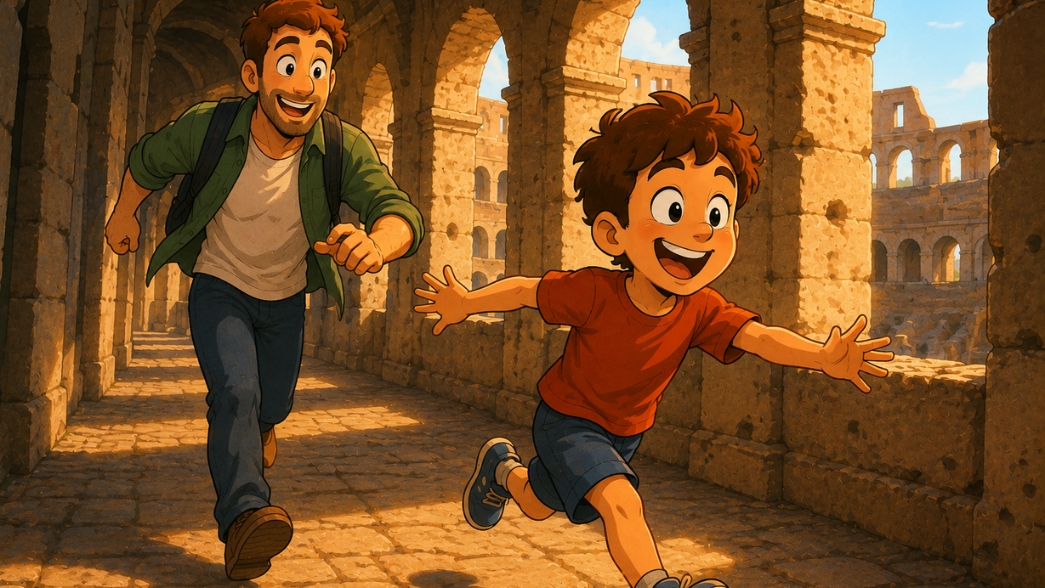
But they will run ahead to find the thing you told them to look for. They will remember the specific shocking fact you mentioned before you even arrived at the sight. They will ask questions that most adults never think to ask. They will discover things nobody else noticed because they’re looking everywhere at once.
The child who struggles most in a traditional museum setting is often the child who engages most deeply when given the right format.

What Doesn't Work - And Why
Before getting to what does work, it’s worth being honest about what doesn’t.
Audio guides. The average attention span for a child with ADHD is significantly shorter than the average audio guide assumes. A device that delivers forty-five minutes of continuous narration is not designed for a brain that processes in bursts. Most children with ADHD will stop listening within five to ten minutes – not because the content isn’t interesting, but because the format is wrong.
Group tours. Fixed pace, fixed route, fixed schedule. No ability to speed up when energy is high, slow down when overwhelmed, or step outside when the stimulation becomes too much. Group tours are also typically the highest-sensory environments – crowded, loud, with limited ability to move freely.
Long indoor stretches without breaks. The Vatican Museums are approximately seven kilometres of corridors. Without strategic planning, this is an extremely difficult environment for a child with ADHD, regardless of how extraordinary the content is.
Information delivered without action. Telling a child with ADHD about something rarely works as well as having them do something with it. The engagement comes from the doing – finding, solving, discovering — not from the receiving.
What Actually Works
Short bursts with clear endpoints.
A child with ADHD can often sustain intense focus for shorter periods than neurotypical children – but that focus, when it’s present, is genuinely deep. The goal is to work with this pattern rather than against it.
Plan your day in 45-60 minute blocks with a genuine break between each. Not a “let’s walk to the next sight” transition, but an actual stop – gelato, a park, sitting by a fountain, something with no educational agenda.
This feels counterintuitive when you’ve flown to Rome and want to see everything. It produces a dramatically better day.
One specific thing to find at each sight.
Before you arrive anywhere, give your child a mission. Not “we’re going to see the Colosseum.” That’s a passive experience. Instead: “There are 28 secret elevators hidden under the arena floor. Find where they were.”
The specificity matters enormously. “Look at the ceiling” produces glazed eyes. “Find the shape that Michelangelo hid in the ceiling that took 500 years for anyone to notice” produces forty minutes of genuine engagement.
This single shift – from passive observation to active mission – changes the experience more than almost anything else.

The shocking fact before the sight.
Children with ADHD often engage best when their interest is already activated before they arrive somewhere. Tell them the most surprising fact about the place before you get there – not as a lecture, but as a hook.
Standing outside the Colosseum: “They once flooded this entire arena with water and had a full naval battle inside. With ships.”
The child who was dragging their feet is now looking up at the building differently. Their brain is already asking questions – how, how much water, how big were the ships – and they arrive curious rather than obligated.
Movement as a feature, not a problem.
Children with ADHD often process better when they’re moving. Rome is an unusually walkable city, and the historic centre rewards exactly the kind of exploratory, slightly unpredictable movement that ADHD brains excel at.
Let them lead some of the walking. Give them the map or the phone. Tell them what you’re looking for and let them navigate. A child with ADHD who is navigating is engaged; a child with ADHD who is being walked somewhere is not.
LooksArt – designed for exactly this.
We built LooksArt around the principle that children learn by doing, not by listening. Every adventure through the Colosseum, Historic Rome or the Vatican is built around missions, riddles and discovery – not passive narration.
For children with ADHD specifically, this format addresses several of the core challenges at once.
The missions provide clear, achievable goals with immediate feedback – exactly the dopamine loop that ADHD brains respond to best. There’s always a next step, always something specific to find, always a reason to keep moving forward.
The self-guided format means you control the pace entirely. Speed up when energy is high. Stop when the environment becomes overwhelming. Take a twenty-minute gelato break in the middle and pick up exactly where you left off. The adventure waits.
The game element means the engagement is intrinsic rather than obligated. A child who is playing doesn’t need to be persuaded to keep going.
And the gelato reward at the finish line is a significant motivator for ADHD brains that respond strongly to concrete, near-term rewards.

Practical Planning for ADHD in Rome
Time of day matters enormously.
If your child’s medication is most effective in the morning, plan the most demanding sights – Vatican Museums, Colosseum interior – for that window. Afternoons in Rome are also genuinely difficult in summer heat, which compounds any attention or regulation challenges.
Early mornings in Rome are extraordinary – quiet, cool, with almost no crowds. For a child with ADHD, arriving at the Colosseum at 9am versus arriving at noon is the difference between an engaging visit and a survival exercise.
Sensory considerations.
The Vatican Museums in high season are extremely crowded, loud and warm. For a child with sensory sensitivities alongside ADHD, this combination can be genuinely overwhelming. Book the first entry slot of the day, skip the Pinacoteca entirely, and have a clear exit plan – a specific place to go if you need to step outside and reset.
Earphones and a familiar podcast or music can help during transitions between sights – something to regulate with while walking, rather than having to process the full sensory input of a busy Roman street.
The conversation before you go.
Children with ADHD often do better with clear information about what to expect. Not a rigid itinerary, but a genuine conversation: here’s what we’re going to see, here’s roughly how long we’ll be there, here’s what we’re going to do when we need a break. Reducing uncertainty reduces the cognitive load, which leaves more capacity for actual engagement.
Build in genuine choices.
Give your child real agency over at least one decision per day. Which gelato flavour. Which direction to walk. Whether to go into one more sight or call it a day and find a park. ADHD brains often regulate better when they have some genuine control over their environment – and Rome, designed around wandering rather than efficiency, accommodates this better than most cities.

What Parents Tell Us
After years of taking families through Rome – including many families who came to us specifically because previous trips had been difficult – the feedback we hear most consistently about LooksArt from parents of children with ADHD is some version of the same thing.
“He was the one pulling us forward. He didn’t want to stop.”
“She found details none of the adults had noticed. She was proud of herself in a way that didn’t happen on our last trip.”
“It was the first time at a museum where I wasn’t managing the whole time. I actually got to see things too.”
That last one matters. A trip to Rome with a child with ADHD, planned well, is not a trip where one parent spends the day managing while the other enjoys. It can be genuinely shared – if the format is right.
The Honest Summary
format of the experience to match how your child actually engages with the world.
Short focused blocks. Specific missions before each sight. Movement built in as a feature. Real agency over some decisions. And a self-guided adventure that works with an ADHD brain rather than against it.
The child who struggles most in a traditional museum tour is often the child who remembers the most, asks the most interesting questions and leads the way most confidently when the format is right.
Rome has extraordinary things to offer that child. You just need to find the right way in.
“What I hear, I forget. What I do, I understand.” – Aristotle

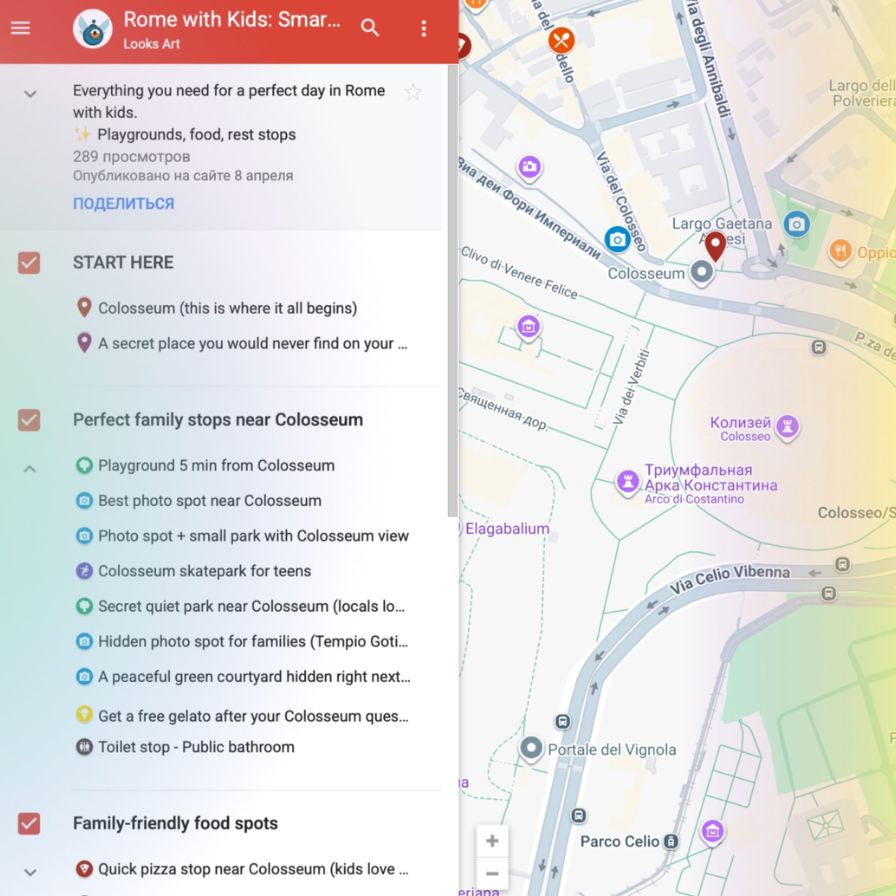
🗺️ GET OUR FREE SMART FAMILY MAP
Quiet spots, shaded parks, sensory-friendly breaks near Rome’s main sights – all on one map, tested by a local Rome mum with 10 years of experience.
Follow us on Instagram @looksart.eu and send MAP in a direct message.