
Rome in 3 Days with Kids: The Perfect Family Itinerary
Three days in Rome with children. It sounds like either the best holiday you’ve ever had or a logistical nightmare involving queues, heat, hunger and at least one complete meltdown outside a monument you’ve wanted to see your entire life.
It can be both. But with the right plan – it’s almost entirely the first one.
This itinerary was built by someone who has spent 10 years taking families through Rome. Every timing, every restaurant recommendation, every hidden rest stop is here because it actually works – tested on real families, with real children, in real Roman summer heat.
Three days. Done properly.
Before You Arrive: The Non-Negotiables
Before we get to Day One, there are three things you must do before you land in Rome. Not suggestions. Non-negotiables.
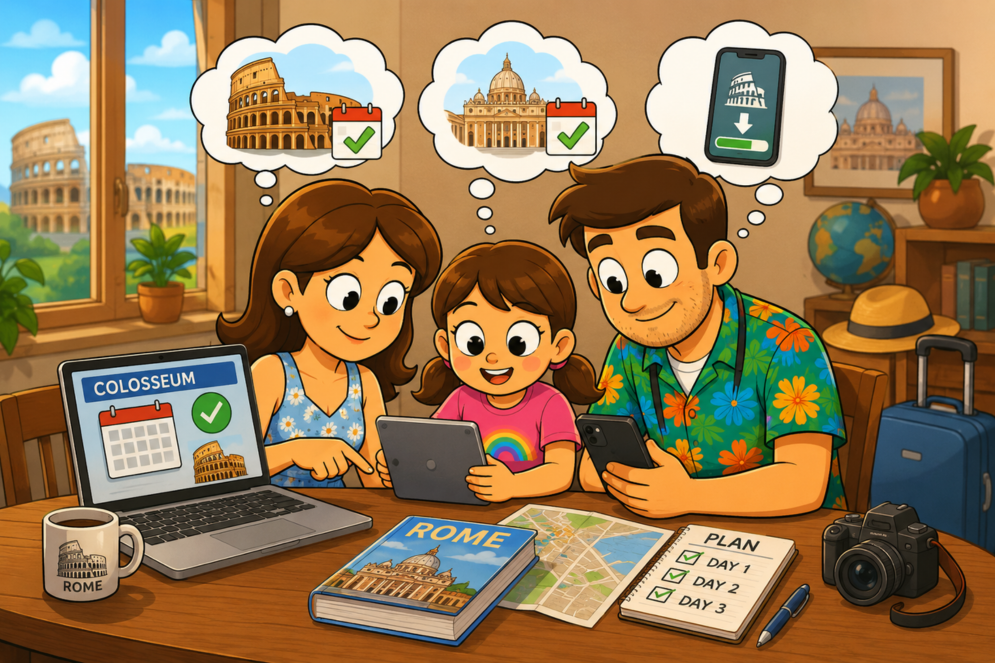
- Book your Colosseum tickets now. The official site is ticketing.colosseo.it. Tickets open exactly 30 days in advance. In high season they sell out within hours. Set a reminder on your phone. Children under 18 enter free but you still need to add their ticket when booking.
- Book your Vatican Museums tickets now. The official site is tickets.museivaticani.va. Same principle — book at least 30 days ahead. Do not buy from resellers.
- Download LooksArt before you travel. Our self-guided family adventures work fully offline. Download the app and your chosen adventures at home so everything is ready when you arrive. No WiFi needed at the sites. iOS / Android
DAY ONE: The Colosseum and Ancient Rome
Start where Rome started. The ancient city is the most dramatic introduction to Rome that exists — and for children, it is genuinely unlike anything they have ever seen.
Morning: The Colosseum. Arrive at 9:00.
The Colosseum opens at 9:00 and the first hour is the quietest of the day. By 10:30 the tour groups arrive in force. Your window for a calm, uncrowded Colosseum experience is roughly 9:00 to 10:15. With children, plan for 90 minutes inside. This is enough time to see the main floor, the upper tiers and the underground hypogeum if your ticket includes it – without anyone’s legs giving out.
What to actually look at with children:
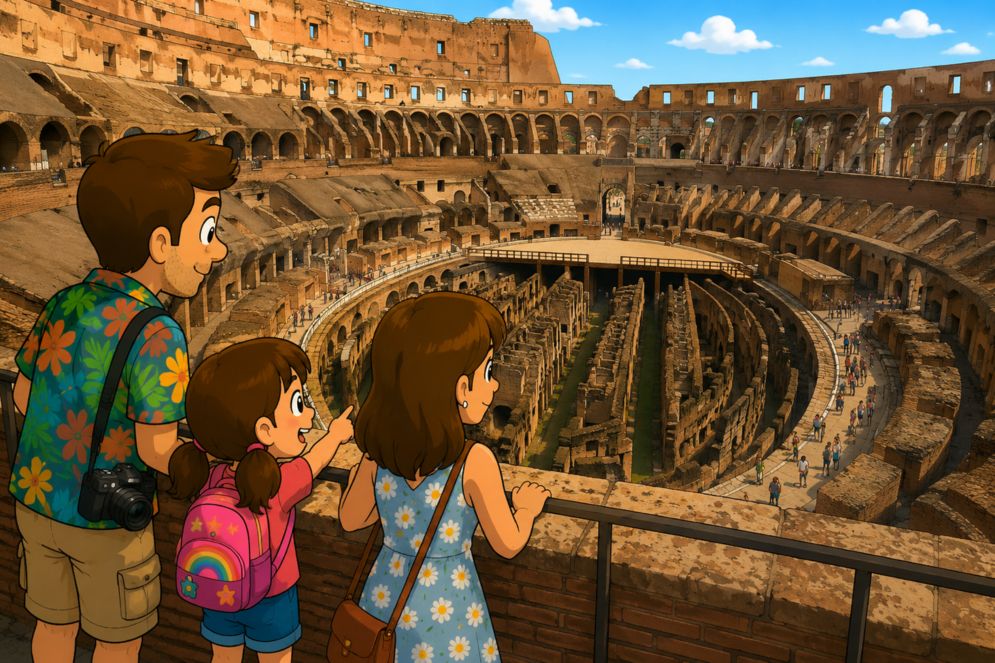
The arena floor reconstruction – the wooden platform that gives a sense of what gladiators actually stood on. Ask children to imagine standing there with 50,000 people watching.
The underground hypogeum – the network of tunnels and rooms beneath the arena where gladiators and animals waited before their moment. Children find this extraordinary. The idea that lions and bears were kept directly beneath the arena floor is the kind of detail that stays with them. The arches – 80 of them on the exterior. Ask children to count them on the walk around. They never get all 80 but they always try.
This is where Colosseum Secrets: Family Adventure comes in. Instead of walking through the Colosseum reading information panels, children follow Una and Archebot through 280 stops of missions, stories and discoveries. They find hidden details, answer riddles and piece together what life was actually like in Ancient Rome.
The result is that children who would normally last 20 minutes in a historic site stay engaged for the full 90. We have the reviews to prove it.
Mid-Morning: The Roman Forum and Palatine Hill
Your Colosseum ticket includes entry to the Roman Forum and Palatine Hill – use it.
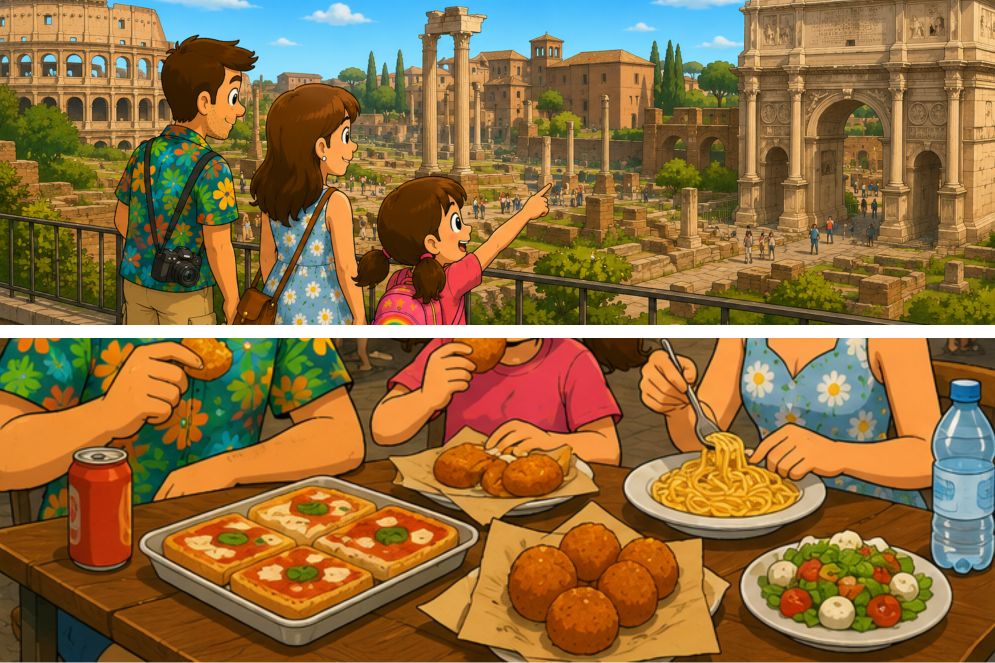
Exit the Colosseum and walk directly into the Forum. For children, the honest truth is that the Forum is harder to engage with than the Colosseum – it’s a large field of ruins without the drama of the arena. Keep it to 30 minutes and focus on two or three specific things rather than trying to see everything.
The things that work with children:
The Temple of Julius Caesar – there is often a small pile of flowers left here by visitors. Tell children this is where Caesar was cremated after his assassination. The reaction is always the same: genuine shock that something this old and this dramatic actually happened here.
The Arch of Titus – ask children to find the carved relief showing Roman soldiers carrying the Menorah from the Temple in Jerusalem. It is one of the most historically significant pieces of sculpture in Rome and children who find it feel like real archaeologists.
Lunch: Testaccio
From the Forum, walk or take a short taxi to Testaccio – Rome’s most authentic food neighbourhood and one of the most toddler-friendly areas in the city.
Where to eat:
Testaccio Market – not a restaurant but the best option for families. A covered market with food stalls selling everything from supplì to fresh pasta to pizza al taglio. Children can choose what they want, the prices are local and there is no waiting for a table.
For a sit-down lunch: Flavio al Velavevodetto – a proper Roman trattoria with outdoor tables, a relaxed attitude toward children and some of the best cacio e pepe in the city.
After lunch:
the Testaccio neighbourhood has a good park just behind the market. Use it for a 30-minute break before the afternoon.
Afternoon: Villa Celimontana
This is the secret that most tourists never find.
Villa Celimontana is a shaded park five minutes walk from the Colosseum. Ancient Roman columns are hidden in the gardens. There is a small playground. The grass is long and green and there is almost always space to sit quietly. No crowds. No entrance fee.
After a morning at the Colosseum and lunch in Testaccio, this is exactly the right pace for the afternoon. Children run. Parents sit. Everyone recovers.
Evening: Dinner Near the Colosseum
One important rule: do not eat in the restaurants immediately surrounding the Colosseum. The prices are tourist prices and the quality reflects that.
Walk instead to the Celio or Aventino neighbourhoods – ten minutes from the Colosseum – where local restaurants serve proper Roman food at proper Roman prices.
Recommend: Ristorante Aroma – if budget allows, the rooftop terrace with Colosseum views is one of the most spectacular dining experiences in Rome. For something more casual, the streets of the Celio neighbourhood have several excellent trattorias.
End the evening with a walk back past the Colosseum after dark. The golden floodlights on the ancient stone at night are genuinely breathtaking – a different building entirely from the one you visited in the morning.
DAY TWO: Historic Rome - From Piazza Venezia to the Pantheon
Day Two covers the historic centre – the Rome of fountains, piazzas, gelato and the kind of beauty that stops you mid-sentence.
Morning: Piazza Venezia and the Vittoriano
Start at Piazza Venezia – the geographical heart of Rome and the point from which all distances in Italy are measured.
The Vittoriano – the enormous white marble monument that dominates the square – is free to enter and worth ten minutes inside. Take the lift to the very top for the best panoramic view in Rome. Children love it. The lift costs a few euros and the view repays it immediately.
From Piazza Venezia, walk down Via del Corso toward the Pantheon. This is one of the great walks in Rome – 15 minutes through the heart of the historic centre, past churches, palaces and the kind of street life that makes Rome feel like a living city rather than an outdoor museum.
Mid-Morning: The Pantheon
The Pantheon is one of the best-preserved ancient buildings in the world. It has been standing for nearly 2,000 years. The dome – with its famous oculus open to the sky – is an engineering achievement that astonished architects for centuries.
Entry note: the Pantheon now charges an entry fee. Book in advance at pantheonroma.com to avoid the queue.
What works with children:
The oculus – the circular opening in the dome, 9 metres wide, open to the sky. When it rains in Rome, it rains inside the Pantheon. There is a drainage system built into the ancient floor. Children find this extraordinary.
The dome mathematics – the Pantheon’s dome is a perfect sphere. If you placed a ball the exact size of the interior inside the building, it would touch the floor and the oculus simultaneously. Ask children to visualise this. The ones who get it are always delighted.
Raphael’s tomb – the Renaissance painter is buried here, in a simple tomb that seems almost impossibly modest for one of the greatest artists who ever lived.
Our Discover Rome: Family Adventure covers exactly this route – from Piazza Venezia to the Pantheon, through the Campo de’ Fiori and on to the Trevi Fountain. Children follow Una and Archebot through 280 stops of missions, stories and hidden discoveries. Parents follow children. Everyone arrives at the gelato finish line.
Lunch: Campo de’ Fiori. From the Pantheon, walk ten minutes to Campo de’ Fiori – one of Rome’s most beautiful squares and the site of a morning market (runs until 14:00).
For lunch: the streets immediately surrounding Campo de’ Fiori have dozens of good options. Avoid the restaurants directly on the square – prices are elevated. One street back, the quality rises and the prices fall.
For children: the pizza al taglio places on Via dei Baullari are excellent and fast.
Afternoon: Trevi Fountain and the Spanish Steps. After lunch, walk to the Trevi Fountain – about 15 minutes from Campo de’ Fiori.
The honest advice: the Trevi Fountain is always crowded. Always. The best time to visit is early morning (before 8:00) or late evening (after 21:00). At 14:00 on a summer afternoon it is at peak capacity.
Go anyway. It is still spectacular. Find a position along the outer edge rather than fighting for the centre. Let children throw their coin. Make the wish.
Important note: the Trevi Fountain now has a paid viewing area. Check current arrangements before you visit as these change seasonally.
From the Trevi Fountain, walk to the Spanish Steps – about 10 minutes. The steps themselves are the attraction. Sit, watch the city, eat the gelato you’ve earned.
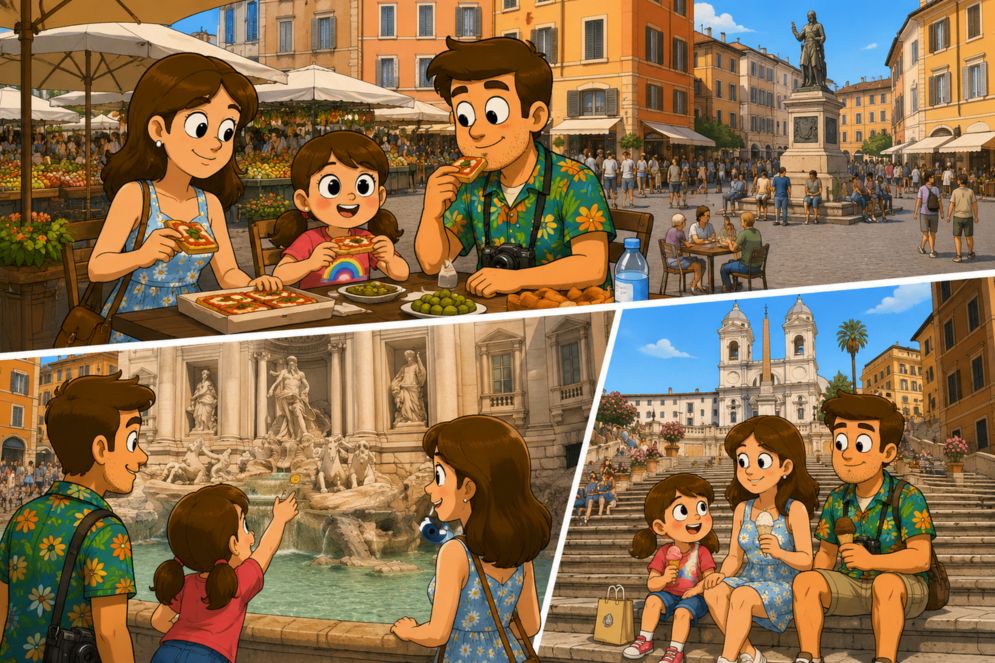
Afternoon Break: Gelateria. You have walked approximately 8 kilometres by this point. Everyone deserves gelato.
Our recommendations near the historic centre:
Giolitti – one of Rome’s oldest gelaterias, near the Pantheon. Classic, reliable, always good.
Della Palma – enormous selection, central location, popular with children for the sheer number of flavours.
Fatamorgana – if anyone in the family wants something genuinely unusual. Flavours include basil, rose and Gorgonzola. Children are either fascinated or horrified. Both reactions are entertaining.
Evening: Trastevere. Take a taxi or walk 20 minutes to Trastevere for dinner. This is Rome’s most atmospheric neighbourhood in the evening – lantern-lit streets, outdoor tables, the sound of music from somewhere nearby.
For families: Piazza di Santa Maria in Trastevere is the perfect evening destination. The fountain is beautiful, the square is pedestrian-only and there is space for children to run while parents sit at the surrounding café tables with something cold.
In summer, the piazza sometimes hosts outdoor film screenings in the evening. Check listings in advance.
DAY THREE: The Vatican
They’re ready for something genuinely spectacular.
Morning: Vatican Museums
Arrive at 14:00.
Wait – we know. Everything says go in the morning. But with children, the afternoon visit to the Vatican Museums is consistently better. The morning rush of tour groups has passed. The corridors are quieter. The Sistine Chapel – always the most crowded room – is calmer.
A 14:00 arrival gives you two solid hours before closing. For children aged 6-14, two hours is exactly right.
The route we recommend:
Start in the Pinecone Courtyard – open, spacious, a moment to breathe before the corridors begin.
Gallery of Maps – 40 maps of Italian regions painted on the ceiling in the 16th century. Find the sea monsters in the coastal maps. Children who find them feel like genuine detectives.
Raphael Rooms – find the figure of Michelangelo sulking alone in the School of Athens. Ask children why he looks so unhappy. (Nobody actually knows, which makes it better.)
Sistine Chapel – enter, find a space along the walls, look up. Give everyone a moment of silence before the explanations begin. Ask children to find the finger of God touching Adam. Then ask them to find the hidden symbols that Michelangelo snuck past the Pope.
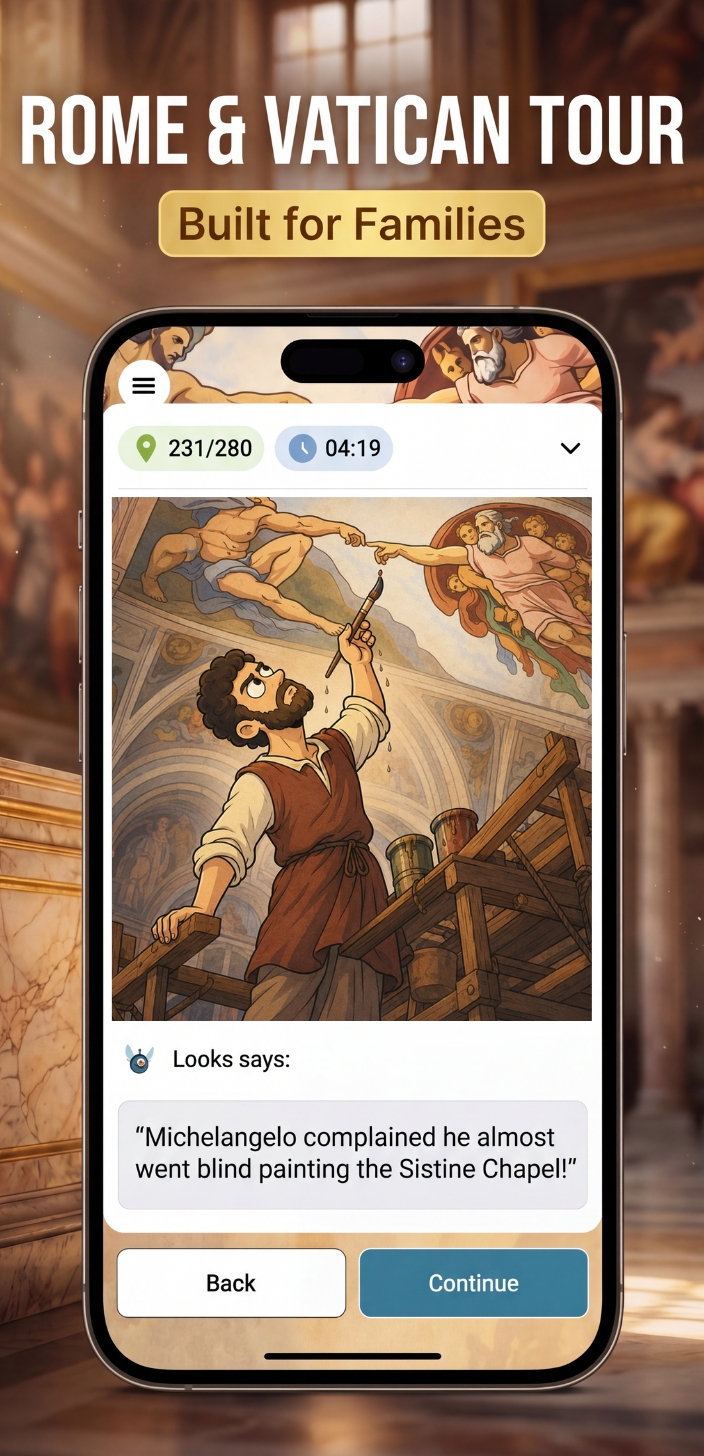
Our Vatican Secrets: Family Adventure turns every one of these rooms into a mission. Children are investigators from the moment they arrive. Parents are teammates. The Sistine Chapel becomes not a room to walk through but a puzzle to solve.
After the Vatican: Castel Sant'Angelo
The Vatican Museums exit near Castel Sant’Angelo – the circular fortress on the Tiber River that served for centuries as a papal refuge.
Walk across the Ponte Sant’Angelo – the bridge lined with angel sculptures – for one of the best views in Rome. The angels were designed by Bernini. Children who have done the Vatican adventure will recognise some of the stories.
Castel Sant’Angelo itself is worth 45 minutes inside. The views from the top are spectacular. The secret corridor connecting it to the Vatican – the Passetto di Borgo – is the kind of detail that genuinely excites children. A secret tunnel. Used by actual popes. To escape actual invasions.
Evening: The Final Gelato
Every LooksArt adventure ends with a real gelato reward. Day Three ends the same way.
Our recommendation for the final evening gelato: find somewhere local, sit outside and let the children choose their flavour without any input from adults. This is always the right call.
The Three-Day Summary
Day One: Colosseum, Roman Forum, Testaccio lunch, Villa Celimontana
Day Two: Vittoriano, Pantheon, Campo de’ Fiori, Trevi Fountain, Trastevere dinner
Day Three: Vatican Museums, Castel Sant’Angelo, final gelato
Three days. Three adventures. One city that will stay with your family for the rest of your lives.
The secret is not in seeing everything. It’s in seeing the right things – slowly enough that children actually absorb them, interactively enough that they remember them, and with enough gelato breaks that everyone arrives home happy.
🗺️ GET OUR FREE SMART FAMILY MAP
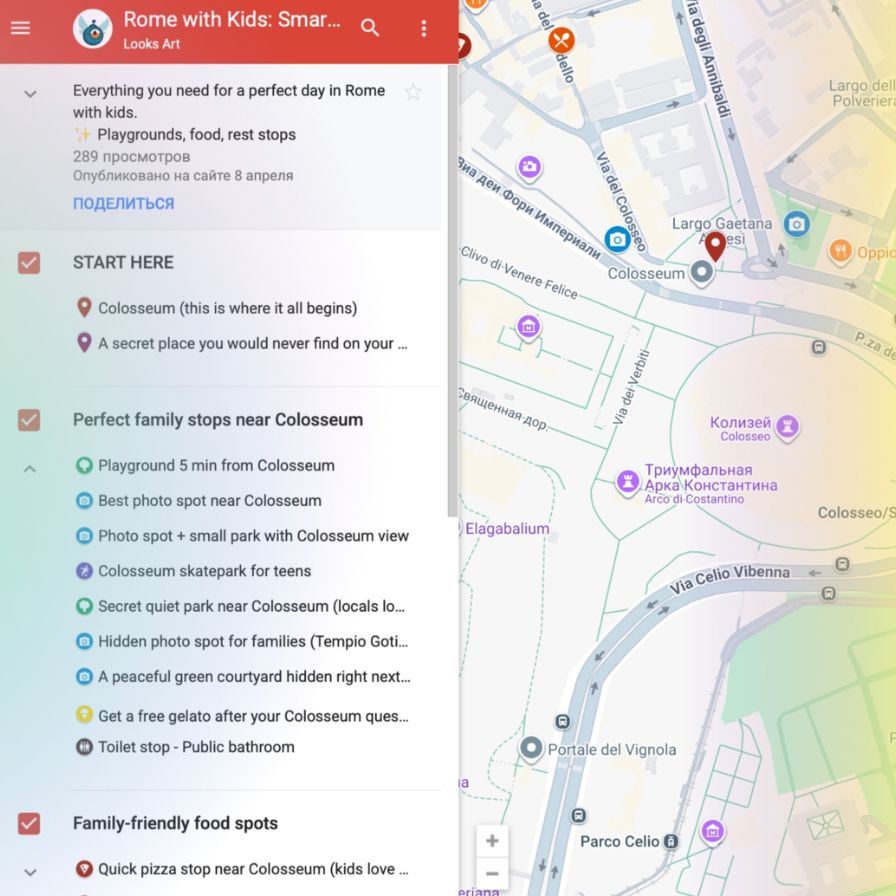
Every restaurant, playground, nasoni fountain, hidden rest stop and local secret near all three routes – all on one map, tested by a local Rome mum with 10 years of experience.
Follow us on Instagram @looksart.eu and send MAP in a direct message. We’ll send it straight to you. 🗺️
Start Your Roman Adventure:
🏛️ Colosseum Secrets: Family Adventure – Day One
🍦 Discover Rome: Historic Centre – Day Two
✝️ Vatican Secrets: Family Adventure – Day Three