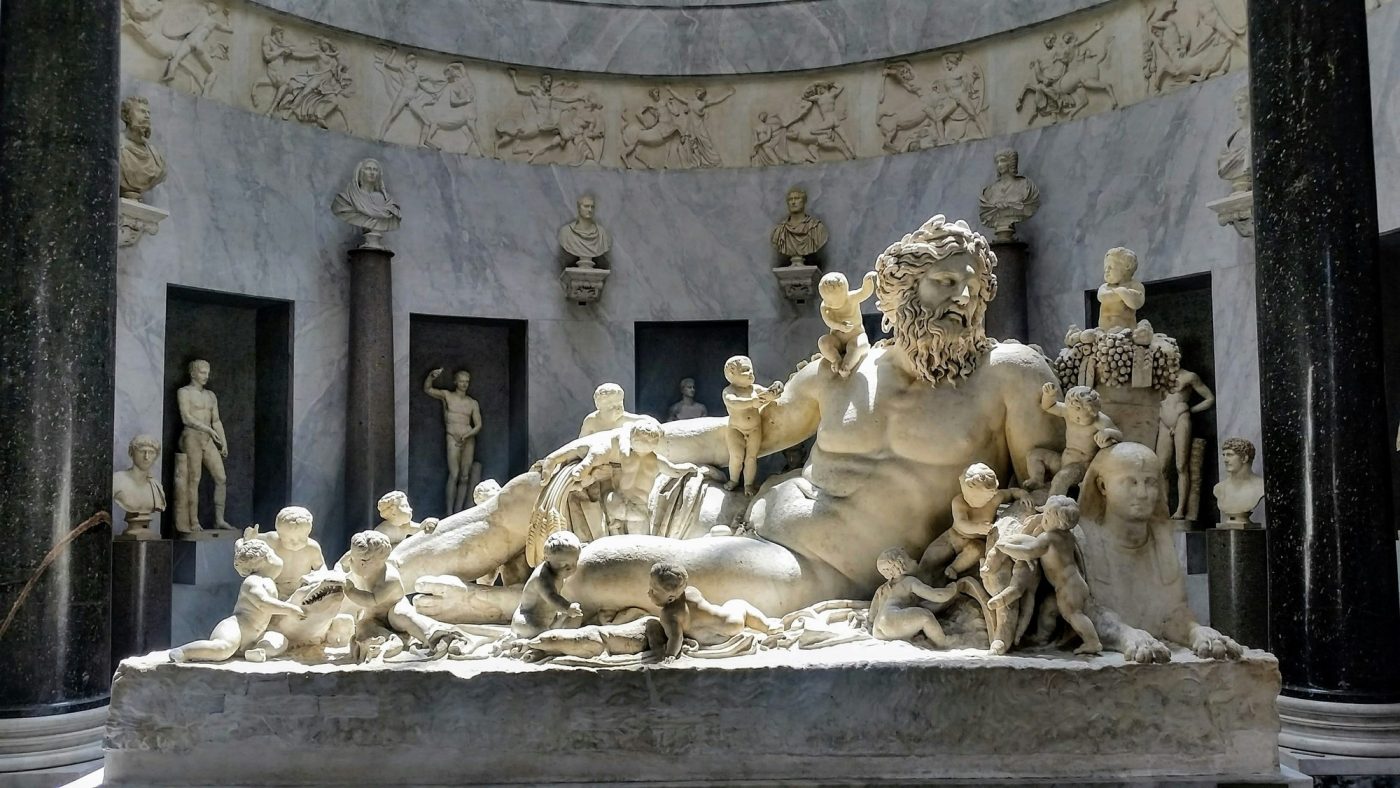
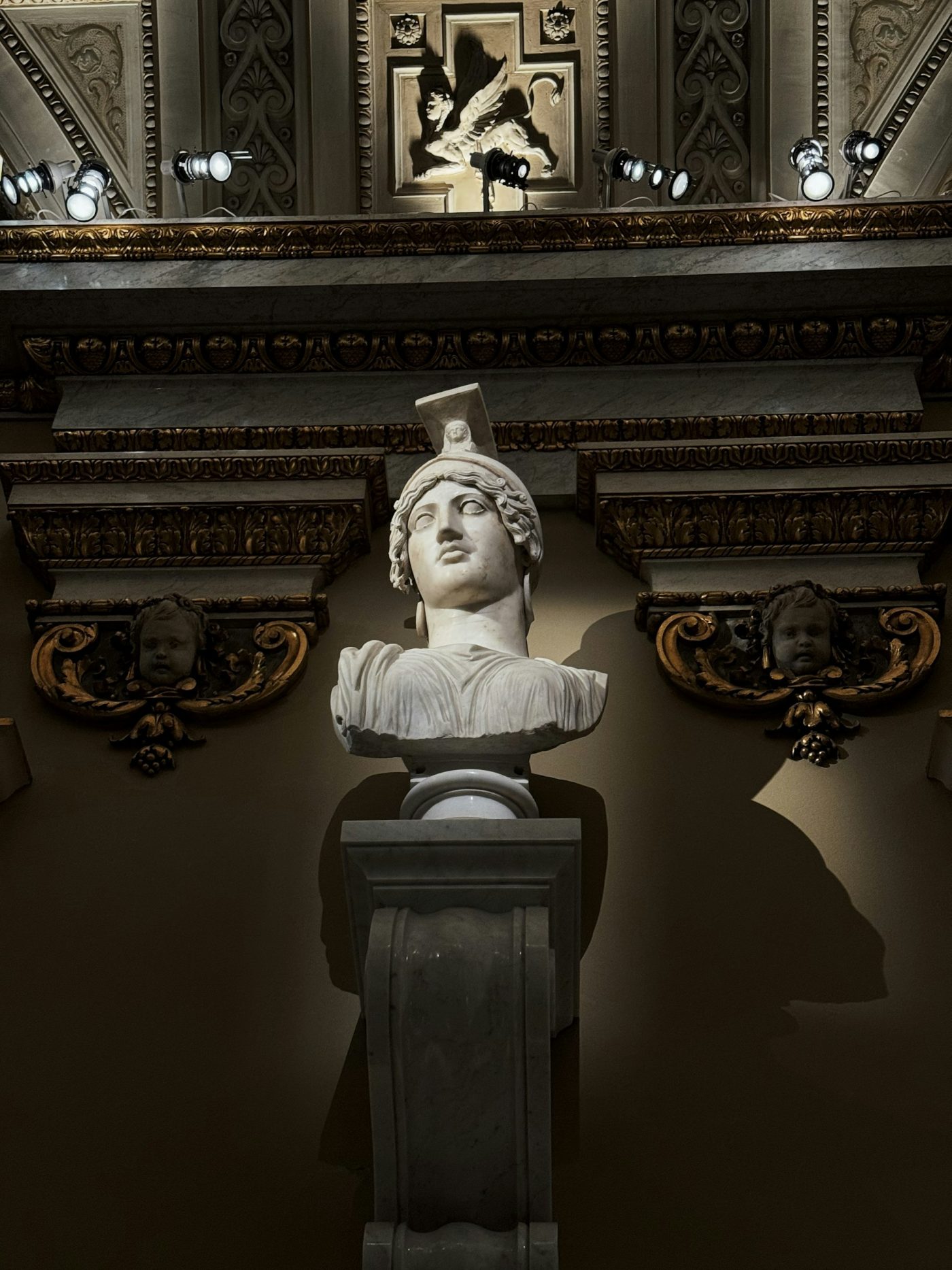
Rome conquered Greece, but Greece conquered Rome’s imagination. From the second century BC Roman workshops copied Greek masterpieces, and today those copies stand in four museums across the city, from the Vatican to the Capitoline hill.
To a child, unfortunately, that is a city of motionless statues. Yet every one of them carries a plot with monsters, chases and transformations, and the moment you tell it the marble comes alive. Below are ten statues, their stories, and a route that does not drown in them.
Why myths work where art does not
A seven to twelve-year-old can do nothing with “a Roman copy of a Greek original of the fifth century BC”. But they understand perfectly the story of a man who warned his people about a danger and was punished by the gods for it.
A myth gives a statue what it lacks: character, conflict and an ending. The child stops looking at stone and starts hunting for detail — who is who here, what is about to happen, how it ended.
So the order in this article is the reverse of the usual: story first, marble second. The other way round does not work.
Four museums: what is where and how long
The ten statues are spread across four museums, and doing them in one day is impossible. Split them over two or three outings and every one will go well.
| Museum | Who stands there | Time | Booking |
|---|---|---|---|
| Vatican Museums | Laocoön, Apollo Belvedere | 1.5–2 hours | required, 2–3 weeks ahead |
| Capitoline Museums | Dying Gaul, Venus, Amor and Psyche, Wounded Amazon, Hermes | 1.5 hours | not needed |
| Palazzo Massimo | Apollo of the Tiber | 1 hour | not needed |
| Borghese Gallery | Apollo and Daphne, Aeneas | 2 hours | required, timed entry |
The best single day is the Capitoline Museums: five of the ten statues in one building, no booking needed, and a view over the Forum from the windows.
Ten statues and their stories
1. Laocoön and his sons
Vatican Museums
A Trojan priest warned his people that the wooden horse was a trick. The gods, who had already settled Troy’s fate, sent two sea serpents, and they strangled Laocoön and his sons in front of the whole city.
The statue was found in 1506 and Michelangelo called it a marvel of art. It was made by sculptors from Rhodes — Agesander, Athenodoros and Polydorus — in the first century BC.
A question for your child that always lands: would you have listened to Laocoön?
2. The Apollo Belvedere
Vatican Museums
Apollo one second after the shot: the arrow has gone, the body is still moving, the face is already calm. The myth says that with this arrow he killed the serpent Python and founded the sanctuary at Delphi.
It is a Roman copy of a bronze by Leochares from around 330 BC. For two thousand years it was held up as the model of ideal beauty.
Try holding the pose as a family. Nobody manages more than ten seconds — and that is the real discovery.
3. The Apollo of the Tiber
Palazzo Massimo
A calm statue found in the river Tiber, pulled from the water centuries after it went in. Apollo here is not an archer but the god of light, music and physicians.
A Roman copy of a Greek original of the fifth century BC. Look for the lyre — Apollo almost always has one, and finding it is more interesting to a child than reading the label.
4. The Dying Gaul
Capitoline Museums
A wounded warrior with a torc around his neck leans on his shield. He has lost but he is not broken, and that is the point of him: the Greeks admired the courage of their enemies and put up monuments to them.
A Roman copy of a bronze from Pergamon, third century BC. A good conversation on the way home: why can sadness be heroic?
5. The Capitoline Venus
Capitoline Museums
Aphrodite just risen from the sea — in the myth she was born of sea foam. One of the most copied statues in European history, repeated for centuries.
With children it produces an unexpectedly good conversation about what beauty is, and why it was understood differently two thousand years ago.
6. Amor and Psyche
Capitoline Museums
Eros embracing Psyche, a mortal girl who passed the trials of the gods to win her love back. The myth is more than two thousand years old, and the plot has been retold a thousand times since.
A Roman copy of a Hellenistic original. A task for the evening: retell this myth as a modern fairy tale. Children do it better than adults.
7. Apollo and Daphne
Borghese Gallery
The best statue on this list and possibly in the city. Bernini caught one second: the nymph is fleeing Apollo and turning into a laurel as she runs — fingers becoming leaves, feet becoming roots, bark climbing her skin.
Finished in 1625, after Ovid’s Metamorphoses. Walk all the way round it: every angle shows a different stage of the transformation, and it works like animation.
8. Aeneas, Anchises and Ascanius
Borghese Gallery
Aeneas carries his father out of burning Troy on his shoulders and leads his son by the hand. Three generations in one sculpture — and from that son, the legend says, came the founders of Rome.
An early Bernini. The task is simple and somehow difficult: find all three — son, father and grandson — and work out which is which.
9. The Wounded Amazon
Capitoline Museums
A woman warrior still in a fighting stance, already wounded. Amazons in Greek myth fought both alongside heroes and against them — Heracles and Achilles both faced them.
A Roman copy of a lost Greek bronze from around 430 BC. A game everyone enjoys: invent your own Amazon name.
10. Hermes
Capitoline Museums
God of travellers, roads, borders and quick wits — patron, as it happens, of exactly what you are doing right now. Here he appears in the guise of Antinous, the favourite of the emperor Hadrian: an example of how the Romans merged the divine with the human.
A good closing question: what message would you carry if you were Hermes?
How to tell a myth to a child
- Tell it before, not after. A child who already knows the story walks up to the statue looking for detail. One who does not simply sees marble.
- Do not shy away from the drama. Serpents, chases, transformations — that is what myths are made of, and it does not frighten children as long as it is a story rather than a scene in front of them.
- Connect it to something known. Almost every myth has already been retold in a film or a book your child has seen. One such link is worth ten facts.
- Three or four statues per outing. Nobody survives ten in a row. Between museums: street, square and gelato.
- Bring a notebook and pencils. Myths provoke drawing more than anything else in Rome.
Where LooksArt helps
The real difficulty is having the story to hand at the right second. Reading a long text off a phone in front of a statue is awkward, and remembering ten myths by heart is not possible.
That is exactly what LooksArt solves: the mission and the puzzle appear where you are standing, the child gets a task and the parent a short note. The first quest is free, the full one starts at €29 for the whole family, and it works offline.
Nearby
The Vatican and the Capitoline Museums each make a full day with children, and that is worth preparing for separately.
Frequently asked questions
What age are Greek myths interesting for?
From about seven: at that age heroes, monsters and gods read as stories with characters rather than a list of names. Myths are exactly what turns a city of motionless statues into an adventure.
Which museums hold these statues?
Four of them: the Vatican Museums, the Capitoline Museums, the National Roman Museum at Palazzo Massimo and the Borghese Gallery. The ten stops are spread across all four, so one day will not cover them.
Do we need to book the Borghese Gallery?
Yes. Entry runs in timed slots with a limited number of visitors, and without a booking you may simply not get in. The Borghese is where Bernini’s Apollo and Daphne and Aeneas stand.
Will these stories frighten a child?
Laocoön with the serpents and the Dying Gaul are dramatic subjects. One simple trick works: tell the story before the child sees the statue, and discuss it as a story rather than a scene. Then it is gripping rather than frightening.
How many myths per outing?
Three or four within one museum. Ten in a row defeats children and adults alike; spread them over two or three days and link them with the walks in between.
Ready to turn a tour into an adventure?
Start with the free mission by the Colosseum. If you enjoy it, unlock the full tour, from €29 for the whole family.